Apparatus for Demonstrating Reflection, Refraction, Polarization and Diffraction using Microwaves
Product Code : SCL-PL-11848
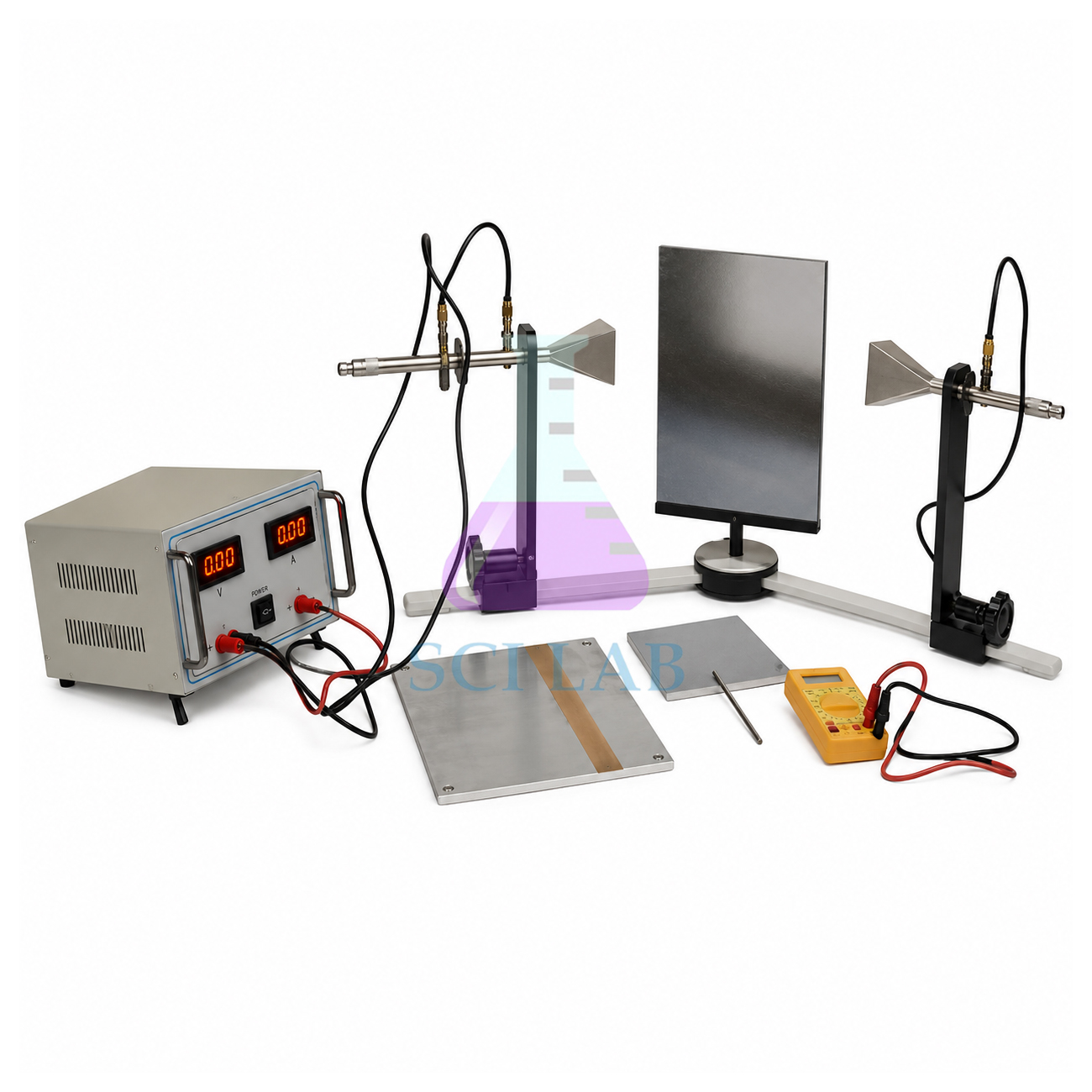
Apparatus for Demonstrating Reflection, Refraction, Polarization and Diffraction using Microwaves (SKU SCL-PL-11848) is a microwave optics set that lets students repeat the classic wave-optics experiments at a 2.8 cm wavelength, for senior secondary and undergraduate physics and electronics labs. Science Lab Supplies builds the whole microwave set at its factory on Plot 448, HSIIDC Industrial Area, Saha, Ambala, India, and manufactures it to order for schools, colleges, tender contractors and distributors.
Specifications
All the transmitter, receiver, probe and reflector data for the microwave set are given row by row below. In short, a 10.7 GHz Gunn-diode transmitter and a matching receiver work with a silicon-diode probe, three aluminium mirrors, an acrylic mirror, a polarising mesh and a digital multimeter.
| Specification | Value |
|---|---|
| SKU | SCL-PL-11848 |
| Transmitter source | Gunn diode |
| Frequency | 10.7 GHz |
| Wavelength | 2.8 cm |
| Power | 30 W |
| Voltage | (10–12) V to (2–3.5) V |
| Transmitter case | Cylindrical, 83 mm diameter, 70 mm long |
| Overall length | 225 mm |
| Receiver | Similar in construction to the transmitter |
| Probe detector | Silicon microwave diode, as in the receiver |
| Probe mounting | Short, vertical, non-metallic rod |
| Probe base | 4 sockets for the external circuit, 75 x 50 x 135 mm |
| Aluminium mirrors | 200 x 300 mm, 50 x 300 mm and 300 x 300 mm |
| Acrylic mirror | 300 x 300 mm |
| Polarising mesh | 190 x 300 mm |
| Other parts | Power source, diode, speaker |
| Meter | Digital multimeter |
| Cables | BNC T cable and BNC cable |
| Manufacturer | Science Lab Supplies, Saha, Ambala, Haryana |
| Country of origin | India |
Applications and Experiments for the Microwave Optics Apparatus
Because a 2.8 cm wavelength is large enough to handle with bench-sized mirrors and meshes, the apparatus lets students show that microwaves reflect, refract, polarise and diffract just as light does. It supports Class 12 electromagnetic-wave and wave-optics topics and B.Sc. or engineering microwave practicals.
- Class 12 physics: placing microwaves in the electromagnetic spectrum and measuring their wavelength, then comparing it with visible light dispersed by a Glass Prism (Equilateral, 50 × 50 mm).
- Law of reflection with the aluminium mirrors, the same law the Light Ray Reflection Demonstrator traces with light, and polarisation with the mesh.
- Diffraction and standing-wave mapping with the probe detector and multimeter in B.Sc. and engineering labs.
Run the transmitter under teacher supervision and keep faces away from its aperture during experiments.
Standard Scope of Supply
The set includes the microwave transmitter, microwave receiver, probe detector with its socket base, a power source, a diode, a speaker, the three aluminium mirrors, the acrylic mirror, the polarising mesh, a digital multimeter, a BNC T cable and a BNC cable.
Packing, MOQ and Lead Time
Whether you need one set for a demonstration bench or several for a physics or electronics department, the quotation from Science Lab Supplies states packing, delivery time and price for that quantity. Related optics lab equipment for schools can join it.
As a registered exporter with an Importer-Exporter Code, Science Lab Supplies is able to ship to buyers in Zambia, Rwanda, South Africa, Qatar, Sri Lanka and Vietnam. The business is registered under Udyam as a manufacturing enterprise (UDYAM-HR-01-0014546) and for GST (GSTIN 06ADEPJ0574F2ZU). Microwave-set enquiries reach the factory through the contact page or the enquiry cart, while departments buying by tender will find the process on the lab tender page.
Frequently Asked Questions
What frequency and wavelength does the transmitter use?
The Gunn diode transmitter works at 10.7 GHz, a wavelength of about 2.8 cm. That wavelength suits bench-scale experiments with the 300 mm mirrors and the mesh, and the matching receiver picks up the beam.
How is polarisation shown with microwaves?
The polarising mesh, 190 x 300 mm, is placed between transmitter and receiver and rotated; the received signal changes with the mesh angle, and the change can be followed on the digital multimeter included in the set.
Is Science Lab Supplies the manufacturer or a trader?
Every microwave set is built by the manufacturer, Science Lab Supplies, in its Saha, Ambala factory in India. Buyers deal with the maker directly, and no agent adds a margin to the quotation.
Related Wave Optics Apparatus
Pairing microwave work with light and water-wave experiments shows that reflection, polarisation, interference and diffraction belong to every kind of wave. These six items, from slit and grating sets to polarising filters and a two-source water tank, can be quoted together with this set.
- Apparatus for Studying Interference from Jungian Cracks and Diffraction by Means of Diffraction Nets — laser diode on an optical bench, with a 200 x 200 mm polarizing mesh and a parallel-faced glass plate.
- Adjustable Double Slit Interference Apparatus — micrometer-controlled slit separation and width on an anodized aluminium frame.
- Diffraction and Interference Study Kit - Teacher's Demonstration Model — red and green multibeam laser with 17.5 mm beam spacing, plus ringed Young’s slits.
- Diffraction Gratings with Holder — three 20 x 10 mm gratings of 100, 300 and 600 lines/mm between glass plates.
- Polarizing Filters — linear polarizing filters in 35 mm square frames, for visible and near-infrared light.
- Apparatus for Demonstrating the Phenomenon of Wave Propagation and Reflection — water tank excited at two points by two forks, with a concave lens and a small diffraction barrier.
Browse the full Physics Lab range, the Light and Optics range for slits, gratings and polarisers, or all physics lab equipment.
Last updated: 22 October 2026