Apparatus for the composition of forces

Product Code : SCL-PL-11413
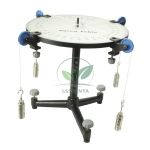
The Equilibrium Forces Composition Apparatus is a calibrated
school instrument engineered for the empirical verification of vector
mechanics, specifically the parallelogram law of concurrent forces and the
equilibrium of parallel forces. Designed for high-frequency use in Secondary
and TVET Physics laboratories, this apparatus facilitates quantitative data
collection for static equilibrium modules, adhering to pedagogical standards
for vocational and scientific training.
Technical Specifications
|
Tender Specification |
OEM Technical Detail |
|
Component Material |
Calibrated Alloy Frame with High-Density Polymer
Components |
|
Dimensions |
45 x 17 x 60 cm |
|
Mass Set Configuration |
8 x 10g slotted masses; 8 x 25g slotted masses |
|
Integrated Measurement |
Precision-indexed protractor for angular vector resolution |
|
Functional Application |
Concurrent and Parallel Force Composition Analysis |
Key Pedagogical
- Precision-indexed
protractor and integrated pulley system: Enables students to calculate
resultant force vectors using the parallelogram rule, supporting Newtonian
Mechanics Module 2.1.
- Variable
10g and 25g mass increments: Allows for the demonstration of
torque and equilibrium conditions in parallel force systems, facilitating
the transition from conceptual to quantitative physics.
- High-stability
60cm vertical chassis: Provides a standardized environment for
students to experiment with multi-vector systems, ensuring
repeatable results in laboratory reports.
International Logistics & Compliance
This school instrument is optimized for international
procurement, utilizing export-grade seaworthy crating (ISPM-15 compliant) to
ensure structural alignment and measurement accuracy during long-range transit.
Every shipment includes a Manufacturer’s Authorization Form (MAF), optional
IQ/OQ documentation for vocational accreditation, and comprehensive technical
manuals in English. The apparatus features a tropicalized finish,
laboratory-tested for operational durability in climates reaching up to 45°C and
90% humidity, preventing oxidation of the force-bearing surfaces.