Creep Testing Machine
Product Code : LSK-MTE-10511
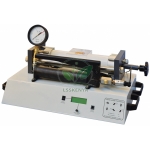
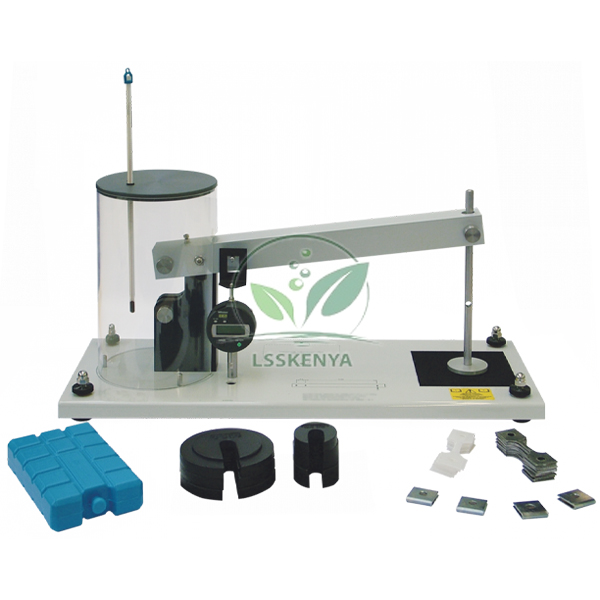
Creep Testing Machine (SKU LSK-MTE-10511) is a simple lever-loaded machine that shows creep, the slow extension of a material under steady load, using lead and plastic specimens that creep noticeably at room temperature and low loads. It suits materials science and strength-of-materials practicals at engineering colleges and polytechnics. Science Lab Supplies manufactures the load beam, frame and enclosure at its factory on Plot 448, HSIIDC Industrial Area, Saha, Ambala, India, and quotes the machine itself to colleges, contractors and distributors.
Specifications
Every element of the 8:1 creep machine is entered in the table below. In short, a lever load beam on a ball-bearing pivot gives a steady, uniform tensile load from weights on a hanger, a digital indicator measures the specimen's extension over time, and a transparent enclosure holds the temperature around the specimen.
| Specification | Value |
|---|---|
| SKU | LSK-MTE-10511 |
| Load beam | Simple lever |
| Mechanical advantage | 8:1 |
| Load type | Steady, uniform tensile load |
| Pivot | Ball-bearing, for correct loading of the specimen |
| Load application | Weights on a weight hanger |
| Creep measurement | Digital indicator for specimen extension |
| Readings | Time and creep |
| Specimens | Lead and different plastics |
| Test conditions | Room temperature and low loads |
| Temperature tests | Frozen or heated cool-pack placed next to the specimen |
| Enclosure | Transparent, preserves the temperature around the specimen |
| Documentation | User guide: equipment details, procedures, theory, results |
| Manufacturer | Science Lab Supplies, Saha, Ambala, Haryana |
| Country of origin | India |
Applications and Experiments for the Creep Testing Machine
With it, students hang weights, then record extension against time to plot creep curves and compare materials and load levels. Placing a frozen or heated cool-pack beside the specimen inside the enclosure shows how temperature changes creep rate, without needing a furnace.
- B.E./B.Tech mechanical and metallurgy: creep curves and the stages of creep, with specimen width and thickness read on a dual-scale Caliper Vernier.
- Polymer and materials science: creep of plastics under constant load; a Laboratory Slotted Masses, 2.5 kg set can be added to the same order for other loading experiments.
- Diploma engineering and TVET: time-dependent deformation and effect of temperature.
Safety: lead is toxic. Handle lead specimens with gloves, wash hands after use and run tests under staff supervision.
Standard Scope of Supply
The machine comes with its 8:1 load beam on a ball-bearing pivot, the weight hanger, the digital extension indicator, the transparent enclosure and a user guide with full equipment details, experiment procedures, theory and results. Specimens, weights and the cool-pack supplied with your order are itemised on the quotation.
Packing, MOQ and Lead Time
Request a quotation for one machine or for each bench in a materials lab. It lists packing, delivery time and price for that quantity, and spare specimens or other test and measurement instruments in India from this range can appear on the same quotation.
Being a registered exporter with an Importer-Exporter Code, Science Lab Supplies can ship to buyers in Vietnam, Malaysia, Peru, Egypt, Iraq and Nigeria. Creep-test enquiries, with spare specimens if needed, are welcome through the contact page or the enquiry cart, and the lab tender page covers purchases made under a formal tender.
Frequently Asked Questions
Why use lead and plastic specimens?
Lead and different plastics creep significantly at room temperature and under low loads, so creep can be seen within a practical session on a simple machine without heating equipment.
How is the effect of temperature studied?
Students freeze or heat a cool-pack, place it next to the specimen and fit the transparent enclosure to hold the temperature around the specimen during the test.
Is Science Lab Supplies the maker of this creep machine?
The lever, pivot and enclosure are fabricated in the Science Lab Supplies factory at Saha, Ambala, and the same team that builds the machine issues your quotation and arranges its supply.
Is documentation provided?
A user guide is supplied with full details of the equipment, detailed experiment procedures, theory and results, so groups can check their creep curves against expected behaviour.
Related Material Failure and Elasticity Apparatus
Creep is one failure mode among several. The machines below cover fatigue, impact, tension and torsion, and the physics-lab apparatus add wire extension and rubber deformation, so students can compare how materials behave under different kinds of loading on one quotation.
- Rotating Fatigue Machine — separate control unit showing load, speed and number of cycles.
- Energy Absorbed At Fracture — cutting jig that repeats the notch position in each specimen.
- Bench Top Tensile Testing Machine — ball-jointed spigots give purely axial loading.
- Torsion Testing Machine — keyway lets the output shaft slide as the specimen length changes.
- Young's Modulus Apparatus (Vernier Type) — 10 cm brass scale with a vernier reading 0.1 mm and a constant cast iron weight.
- Poisson's Ratio of Rubber Apparatus — rubber tube of about one metre with a pointer on a cast iron stand.
Browse the full Material Testing Equipment range, the Elasticity and Surface Tension range for physics deformation apparatus, or all engineering laboratory equipment.
Last updated: 22 October 2026