Clock Bio-Electrolytic
Product Code : LSK-CL-10049
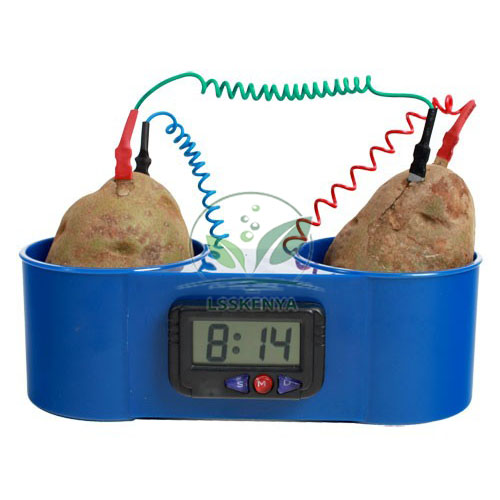
Clock Bio-Electrolytic (SKU LSK-CL-10049) is a small clock powered by copper and zinc electrodes rather than a battery. Students add a moist everyday material – toothpaste, sauces or a cola drink – to the electrodes, and the resulting electrochemical cell keeps the clock running. It is a memorable way to show middle- and secondary-school classes that electricity can come from chemical reactions. Buyers can order it from Science Lab Supplies in Ambala, India, which serves schools, colleges, training institutes, tender contractors and distributors.
Specifications
The unit combines a clock movement with a pair of copper and zinc electrodes. The material placed in contact with the electrodes acts as the electrolyte, so the same clock can be run on many different substances, and the listing notes that it works on almost anything moist enough to conduct ions.
| Parameter | Value |
|---|---|
| SKU | LSK-CL-10049 |
| Also called | Bio-clock, electrolytic clock |
| Electrodes | Copper and zinc |
| Power source | Electrochemical cell formed with added materials (e.g. toothpaste, sauces, cola) |
| Demonstrates | Principle of an electrochemical cell |
| Supplied by | Science Lab Supplies, Ambala, India |
Applications and Experiments for the Bio-Electrolytic Clock
The bio-clock turns the textbook idea of a galvanic cell into something students can test themselves. By swapping the material between the copper and zinc electrodes, they can compare which substances run the clock and connect the result to acidity, dissolved salts and ion movement.
- Class 6–8 science: electricity from chemical reactions and simple circuits.
- Class 10 science: acids, bases and salts as conductors.
- Class 12 chemistry: galvanic cells and electrode reactions, as an introductory demonstration.
- Science fairs and STEM clubs: fair tests comparing household electrolytes.
Wipe the electrodes clean after each trial so that old residues do not affect the next reading; the added materials should not be eaten afterwards.
Standard Scope of Supply
The Clock Bio-Electrolytic is supplied as a single unit with its copper and zinc electrodes, as described above. The materials used to run it, such as toothpaste or sauces, are provided by the user; any optional accessories are listed on the quotation.
Packing, MOQ and Lead Time
You can ask for one clock for classroom demonstrations or several for group investigations. Each quotation lists packing, delivery time and price for the quantity requested, and STEM kits or other electrochemistry items can be priced together.
Science Lab Supplies, a registered exporter holding an Importer-Exporter Code, can ship to buyers in Vietnam, Malaysia, Peru, Egypt, Iraq and Nigeria. Use the contact page for questions and quotes, the enquiry cart to list several products, or the lab tender page for tender supply.
Frequently Asked Questions
What can I use to power the bio-clock?
Almost any moist material that conducts ions, such as toothpaste, sauces or cola. It is placed on the copper and zinc electrodes, which then act as an electrochemical cell.
Does the clock need a battery?
No. The copper and zinc electrodes, together with the material you add, form the cell that runs it.
Who supplies the Clock Bio-Electrolytic?
Science Lab Supplies supplies the clock from Ambala, India, along with simple and Daniell cells for electrochemistry teaching.
Which classes is it suitable for?
It fits middle-school lessons on electricity and secondary chemistry lessons on cells, and works well as a science-fair investigation.
Related Electrochemical Cell Apparatus
Once students have seen the clock run, these four items take the same copper-zinc idea further, from a basic cell to a galvanometer demonstration.
- Cell Simple Copper With Zinc — the same metals in a jar cell.
- Cell Daniel Copper With Zinc — two-solution cell with 1.1 V theoretical output.
- Apparatus for Demonstrating the Galvanic Element (With Galvanometer) — shows the current on a meter.
- Electrode Plate — plates in several metals for own cell designs.
Browse the full Chemistry Lab range or all school lab equipment.
Last updated: 25 September 2026
.jpg)