
Diamond Crystal Model
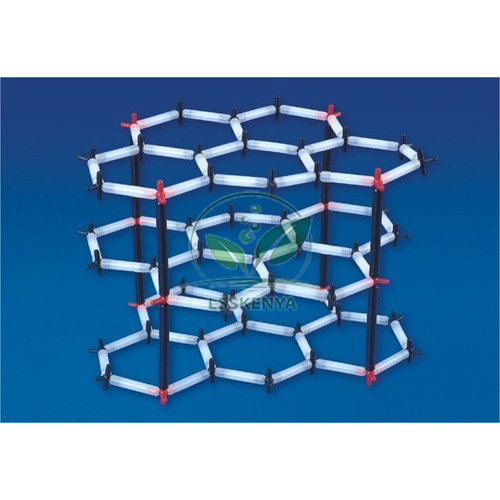
Product Code : LSK-CL-10074
Diamond Crystal Model (SKU LSK-CL-10074) is a build-it-yourself kit of 57 jacks and 84 connectors that assembles into the crystal lattice of diamond, showing how every carbon atom is bonded to four neighbours in a rigid three-dimensional network. Chemistry teachers use it for solid-state and allotropy lessons from Class 10 to B.Sc. level. It is available from Science Lab Supplies in Ambala, India, which delivers to schools, colleges, tender contractors and distributors.
Specifications
The kit is a model of the compound built from separate parts: the 57 jacks stand for carbon atoms and the 84 connectors for the bonds between them. Students or teachers assemble the lattice by following the instruction manual that comes with the set, and it can be taken apart again for the next class.
| Parameter | Value |
|---|---|
| SKU | LSK-CL-10074 |
| Structure modelled | Diamond crystal lattice (carbon) |
| Jacks | 57 |
| Connectors | 84 |
| Documentation | Instruction manual included |
| Supplied by | Science Lab Supplies, Ambala, India |
Applications and Experiments for the Diamond Crystal Model
The model is used to show why diamond is hard and does not conduct electricity: each carbon atom is locked to four others by strong covalent bonds, leaving no free electrons. It supports the allotropes of carbon topic in NCERT Class 10 and the solid state and bonding chapters of Class 11–12 and B.Sc. chemistry.
- NCERT Class 10 carbon and its compounds: comparing diamond with graphite as allotropes of carbon.
- Class 11 chemical bonding: tetrahedral arrangement and sp3 hybridisation of carbon.
- Class 12 and B.Sc. solid state: covalent network solids and the unit cell idea.
- Group activity: students assemble the lattice from the manual and count bonds per atom.
Standard Scope of Supply
The Diamond Crystal Model is supplied as a kit of 57 jacks and 84 connectors together with an instruction manual for assembling the lattice. Nothing else is needed to build it; a storage tray or extra sets for group work can be added to the quotation if you ask.
Packing, MOQ and Lead Time
Quotations can cover a single demonstration kit or several kits for group work in a chemistry lab. Each one from Science Lab Supplies lists packing, delivery time and price for the quantity requested, and the graphite and sodium chloride models can be quoted alongside so the three lattices are compared together.
Holding an Importer-Exporter Code as a registered exporter, Science Lab Supplies can ship to buyers in Egypt, Iraq, Nigeria, Kenya, Ghana and Ethiopia. To start an order, write to us on the contact page or add the kit to the enquiry cart; tender buyers can also see the lab tender page.
Frequently Asked Questions
Does the Diamond Crystal Model come assembled?
It is supplied as a kit of 57 jacks and 84 connectors with an instruction manual, so the lattice is assembled in class and can be dismantled and rebuilt as often as needed.
What does the model teach about diamond?
It shows each carbon atom bonded to four others in a continuous three-dimensional network, which explains the hardness of diamond and why it does not conduct electricity.
Who supplies the Diamond Crystal Model?
Science Lab Supplies supplies the kit from Ambala, India, to schools, colleges and distributors, and quotes for single kits and for class or tender quantities.
How is it different from the Diamond Molecular Model?
This crystal model is a kit you assemble from jacks and connectors. The Diamond Molecular Model is listed separately with its own size and weight; ask for both on one quotation to compare.
Related Crystal and Molecular Models
Diamond is usually taught next to graphite and an ionic lattice such as sodium chloride, and an sp3 orbital model explains the bonding behind it. These four items let a teacher show covalent, layered and ionic structures side by side in one lesson on solids.
- Graphite Crystal Model — the layered allotrope of carbon.
- Sodium Chloride Crystal Model — an ionic lattice for contrast.
- Diamond Molecular Model — an alternative diamond structure model.
- Orbital Model of Sp3 Hybridization — the tetrahedral bonding of each carbon.
Browse the full Chemistry Lab range or all school lab equipment.
Last updated: 25 September 2026
.jpg)

.jpg)