Monocotyledonous and Dicotyledonous Leaves, Cross Section
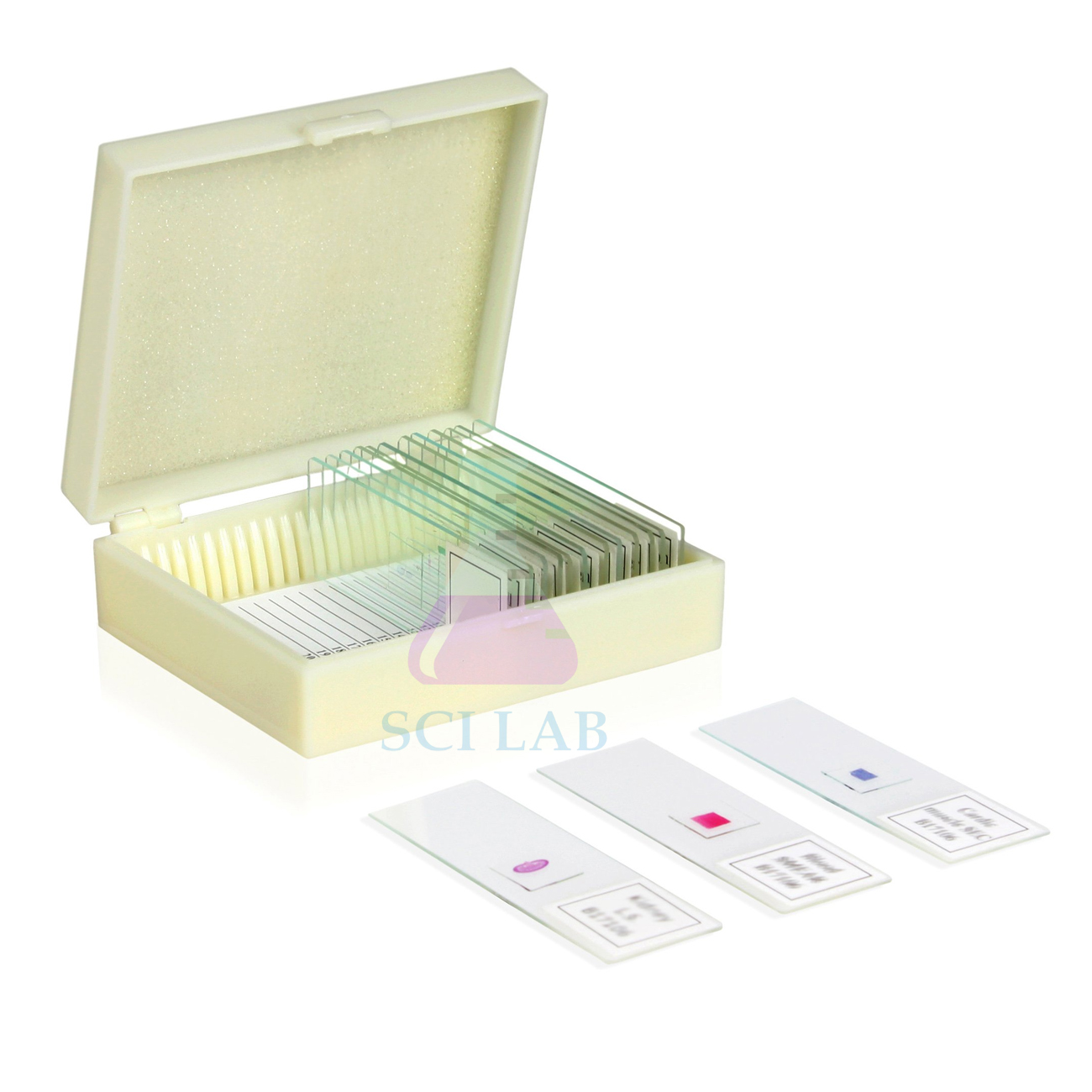
Product Code : SCL-BLE-11683
Monocotyledonous and Dicotyledonous Leaves, Cross Section (SKU SCL-BLE-11683) is a coloured prepared slide with transverse sections of a monocot leaf and a dicot leaf, used to compare how the two leaf types are built for photosynthesis and gas exchange. It serves plant anatomy practicals in senior secondary biology and B.Sc. botany. Science Lab Supplies supplies it from Ambala, India, quoting schools, colleges, training institutes, tender contractors and distributors directly.
Specifications
Specifications of the monocot and dicot leaf slide are listed in the table that follows. In outline, both coloured leaf sections share one rectangular borosilicate glass slide of 25.4 x 76.2 mm (1 x 3 inches), which is delivered in a plastic box.
| Specification | Value |
|---|---|
| SKU | SCL-BLE-11683 |
| Product type | Prepared microscope slide |
| Specimens | Monocotyledonous leaf and dicotyledonous leaf |
| Section | Cross section |
| Preparation | Coloured |
| Slide dimensions | 25.4 x 76.2 mm (1 x 3 in) |
| Shape | Rectangular |
| Slide material | Borosilicate glass |
| Box material | Plastic |
| Use | Laboratory |
| Supplied by | Science Lab Supplies, Ambala, India |
Applications and Experiments for the Monocot and Dicot Leaf Slide
The slide is used to compare dorsiventral and isobilateral leaves. In the dicot section students find palisade cells under the upper epidermis and spongy tissue below; in the monocot section the mesophyll is more uniform, and stomata occur on both surfaces. Veins with xylem and phloem appear in both.
- NCERT Class 11, Anatomy of Flowering Plants: dorsiventral (dicot) and isobilateral (monocot) leaves.
- CBSE Class 10, Life Processes: stomata, guard cells and the site of photosynthesis.
- Class 11–12 and B.Sc. practicals: comparing the prepared sections with students' own leaf peels mounted under Lamella cover slips and coloured with Stains and Reagents for Microscopy.
- Completing a root, stem and leaf anatomy series with the matching slides in this range.
Standard Scope of Supply
The supply consists of one coloured slide carrying monocot and dicot leaf cross sections on 25.4 x 76.2 mm borosilicate glass, in a plastic box. Charts, leaf models, stains and microscopes are not included; they can be added to the quotation as separate lines.
Packing, MOQ and Lead Time
This leaf slide can be quoted on its own or as part of a class order, with no fixed minimum. Your quotation will list the packing, delivery time and price for the requested quantity, and the companion root and stem slides can appear on the same quotation.
Thanks to its Importer-Exporter Code, Science Lab Supplies can ship to buyers in Kenya, Ghana, Ethiopia, Tanzania, Uganda and the UAE. Enquiries about the leaf slide may be sent from the contact page or compiled in the enquiry cart; buyers working to a tender schedule should see the lab tender page.
Frequently Asked Questions
What are the key differences between the two leaf sections?
The dicot leaf has distinct palisade and spongy layers and more stomata on its lower surface, while the monocot leaf has a more uniform mesophyll and stomata on both surfaces. Students record these features to identify each leaf type.
Can this slide be used to show stomata?
Yes, stomata and guard cells can be seen in section in the epidermis of both leaves. For a surface view, a teacher can add a simple epidermal peel, which the prepared section then helps students to interpret.
Who supplies the Monocotyledonous and Dicotyledonous Leaves, Cross Section slide?
It is supplied by Science Lab Supplies from Ambala, India. The company quotes the slide singly or alongside leaf models, charts and other school biology lab equipment in India, then arranges packing and dispatch.
What are the slide's material and size?
The slide is rectangular borosilicate glass of 25.4 x 76.2 mm. Both leaf sections on it are coloured for contrast, and the slide is stored and shipped in a plastic box.
Related Leaf and Plant Anatomy Teaching Aids
These products support the same leaf anatomy and plant structure lessons: charts of monocot and dicot leaf sections, a large leaf model, matching stem and root slides, and plant cell teaching aids. Combining them lets students move from whole leaf to tissue to cell, and all can be quoted together.
- Monocot Leaf T.S. Educational Chart — covers epidermis, mesophyll, stomata, guard cells and vascular bundles.
- Botanical Dicot Leaf T.S. Chart — shows palisade and spongy mesophyll, stomata and the vascular bundle.
- Transverse Section of the Leaf — 300 x 400 mm PVC model with cuticle, stomata, guard cell and vein.
- Monocotyledonous and Dicotyledonous Stems, Cross Section — coloured stem slide in the same borosilicate format.
- Monocotyledons and Dicotyledons, Roots, Cross Sections — root sections that complete the root, stem and leaf series.
- Model of the Plant Cell — colour-coded model showing plastids, vacuoles and nucleus, with key card.
- The Structure of the Plant Cell — wall-mounted laminated chart for classrooms and labs.
Explore the full Biology Lab Equipment range, the Charts and Portraits range, or all school lab equipment.
Last updated: 9 October 2026