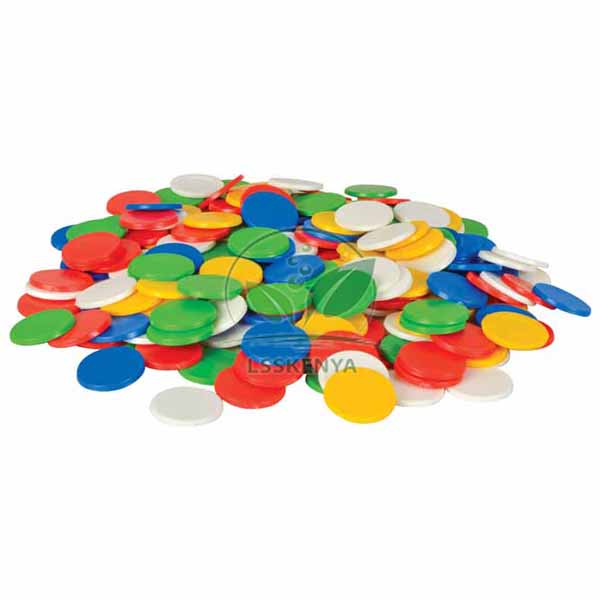
Plastic Counters Colour
Product Code : LSK-ML-10105
Plastic Counters Colour (SKU LSK-ML-10105) is a set of 100 sturdy plastic counters in four colours for hands-on number work. Young learners use them to count, sort and group, and older pupils draw them from a bag to explore probability. The set is a staple of early-years and primary maths corners. Science Lab Supplies is the manufacturer, turning out the counters at its Saha, Ambala works (Plot 448, HSIIDC Industrial Area, India) and supplying schools, colleges, tender contractors and distributors directly.
Specifications
Each set holds 100 counters moulded in sturdy plastic and divided between four colours. The colours give a ready-made attribute for sorting and for probability questions, while the plastic stands up to being handled, dropped and shaken in bags lesson after lesson.
| Parameter | Value |
|---|---|
| SKU | LSK-ML-10105 |
| Quantity | 100 counters |
| Colours | Four |
| Material | Sturdy plastic |
| Demonstrates | Counting, sorting and probability |
| Manufacturer | Science Lab Supplies, Saha, Ambala, Haryana |
| Country of origin | India |
Applications and Experiments for the Plastic Counters
Counters let children touch and move the numbers they are learning about. They are laid out in rows for counting and grouping, sorted by colour to build simple tallies and bar charts, and drawn at random to compare likely and unlikely outcomes in early probability lessons.
- Pre-primary and Classes 1–2: one-to-one counting, number bonds and grouping in tens.
- Primary maths: sorting by colour and recording results as tallies or pictographs.
- Multiplication and division as equal groups and sharing.
- NCERT Class 10 probability: drawing counters from a bag to compare experimental and theoretical results.
Standard Scope of Supply
One set contains 100 sturdy plastic counters in four colours, as described above. Any optional accessories, such as bags or trays for group work, are listed on the quotation only if you ask for them; the counters themselves are the whole standard supply.
Packing, MOQ and Lead Time
Request a price for one set of counters or for enough to give every table its own. Your quotation will show the packing, delivery time and price for that number, and other maths lab manipulatives such as dice and links can be quoted with them.
Science Lab Supplies is registered as an exporter under an Importer-Exporter Code and can ship to buyers in Saudi Arabia, Oman, the Philippines, Nepal, Bangladesh and Zambia. Tell us what you need via the contact page, gather products in the enquiry cart, or follow the tender route on the lab tender page.
Frequently Asked Questions
How many counters are in a set?
Each set has 100 plastic counters split across four colours, enough for a small group to count, sort and run probability trials.
Can the counters be used for probability?
Yes. Because they come in four colours, pupils can draw them from a bag, record which colour appears and compare their results with the expected chance of each colour.
Is Science Lab Supplies a manufacturer or a reseller?
A manufacturer. The counters are produced in the company's own Saha, Ambala factory in India, so prices and delivery dates are quoted by the producer itself.
Can I order counters for several classrooms at once?
Yes. State the number of sets and the delivery address, and all of them can be listed on one quotation with any other maths items you need.
Related Counting and Probability Aids
Counters are often used with dice and other small manipulatives, both for number games and for probability experiments. These four items from the Maths Lab range extend the same activities and can be quoted together with the counters in a single order.
- Dice — standard dice for probability activities and board games.
- Math Symbol Dice — four dice with colours, shapes and numbers on the faces.
- Probability Kit — Binostat, sampling bottles, dice and cards for sampling work.
- Links Colour — plastic links in six colours for counting, patterning and sorting.
Browse the full Maths Lab range or all school lab equipment.
Last updated: 25 September 2026
.png)


.png)