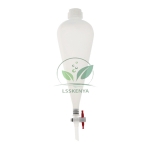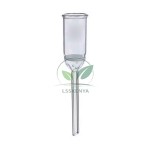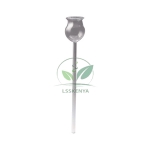
Separating Funnel Gilson Solid Glass Stopcock
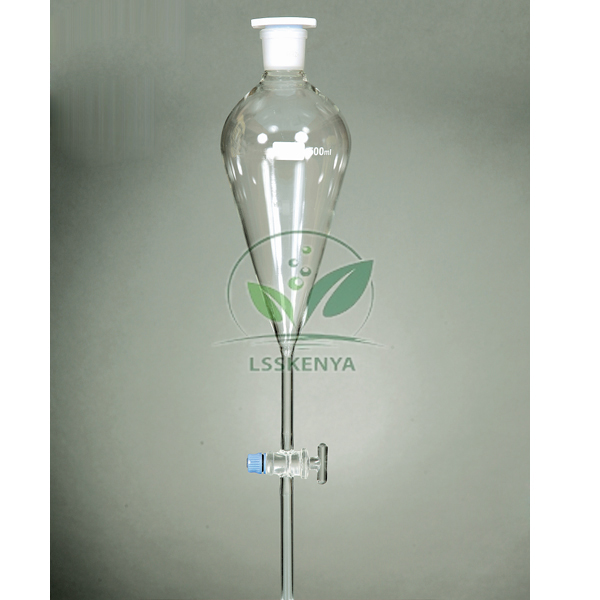
Product Code : LSK-LF-10399
Separating Funnel Gilson Solid Glass Stopcock (SKU LSK-LF-10399) is a Gilson-pattern separatory funnel whose flow is controlled by an all-glass stopcock key, with a PE stopper on the neck. Teaching labs choose it for liquid–liquid separation and extraction practicals where a traditional glass key is preferred. Schools, colleges, pharmacy institutes, contractors and distributors can order it from Science Lab Supplies, which serves them from Ambala, India.
Specifications
The funnel follows the Gilson pattern and uses a solid glass stopcock. Stopcock bores of 2.5, 4 and 6 mm are listed, with a polyethylene stopper available, and there are six capacities running from 50 ml to 2000 ml for classroom and preparative extractions.
| Parameter | Value |
|---|---|
| SKU | LSK-LF-10399 |
| Pattern | Gilson |
| Stopcock type | Solid glass |
| Bore | 2.5, 4 or 6 mm |
| Stopper | Available with PE stopper |
| Capacity | 50 ml, 100 ml, 250 ml, 500 ml, 1000 ml, 2000 ml |
| Supplied by | Science Lab Supplies, Ambala, India |
Applications and Experiments for the Gilson Glass-Stopcock Separating Funnel
Students use this funnel to partition a solute between water and an organic solvent, then draw off the lower layer through the glass stopcock. It fits extraction and separation experiments in higher-secondary chemistry, undergraduate organic labs, pharmacognosy practicals and routine sample preparation in testing laboratories.
- Class 12 chemistry: separating a mixture of two immiscible liquids.
- B.Sc. chemistry: determining a distribution (partition) coefficient.
- B.Pharm pharmacognosy: extracting plant constituents into a solvent layer.
- Testing labs: washing and drying organic extracts before analysis.
A glass key seals well with a thin film of stopcock grease; wipe it and the barrel clean after use so the key does not seize.
Standard Scope of Supply
You receive the Gilson funnel with its solid glass stopcock in place, in the bore and capacity you specify, with a PE stopper available. Stopcock grease, stands, rings and holders are not part of the item and can be quoted separately.
Packing, MOQ and Lead Time
Our team can quote one funnel or a class set in several capacities for a chemistry laboratory. The quotation spells out the packing, delivery time and price for your quantity, and holders or other items from our stock as a laboratory glassware supplier in India can be added on the same page.
Holding an Importer-Exporter Code, Science Lab Supplies as a registered exporter can ship to buyers in Qatar, Sri Lanka, Vietnam, Malaysia, Peru and Egypt. Reach us via the contact page, build a list in the enquiry cart, or see how tenders are handled on the lab tender page.
Frequently Asked Questions
Why choose a solid glass stopcock?
A glass key is the traditional choice for teaching labs: it is inert to most solvents and matches the glass barrel exactly. It needs a light grease film, unlike a PTFE key.
Is there a PTFE version of this funnel?
Yes. The Separating Funnel Gilson PTFE Stopcock is the same Gilson pattern with a PTFE key, listed in the same bores and capacities.
What capacities and bores are listed?
Capacities are 50, 100, 250, 500, 1000 and 2000 ml, and bores are 2.5, 4 and 6 mm.
Who supplies this Gilson funnel?
It is supplied by Science Lab Supplies of Ambala, India, which quotes it to educational institutions, laboratories and tender contractors alone or with other separating funnels.
Related Separating Funnels
These four items round out an extraction bench: the PTFE-key twin of this Gilson funnel, pear and cylindrical funnels offered with a choice of stopcocks, and a polypropylene holder that supports any of them on a retort rod while the layers settle.
- Separating Funnel Gilson PTFE Stopcock — grease-free PTFE key.
- Separating Funnel Pear shape — needle valve, PTFE or glass stopcock.
- Separating Funnel Cylindrical — with socket and cone, 50 to 1000 ml.
- Separatory Funnel Holder — front-opening polypropylene holder.
Browse the full Laboratory funnel range or all school lab equipment.
Last updated: 25 September 2026