Sand Replacement Equipment

Product Code : LSK-SM-10672
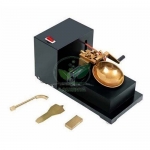
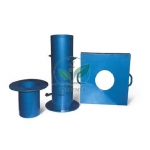
Sand Replacement Equipment (SKU LSK-SM-10672) is used on site to find the in-place dry density of compacted fine and medium-grained soils, in layers up to 50 cm thick, by refilling a dug hole with calibrated sand. Highway, construction and civil engineering students learn field compaction control with it. Science Lab Supplies provides the equipment from Ambala, India to colleges, TVET centres, tender contractors and distributors.
Specifications
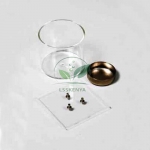
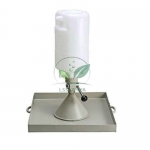
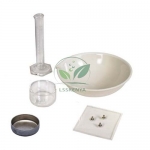
The pouring cylinder is cast aluminium and precisely machined, so sand flows from it at a repeatable rate. A calibration container establishes the bulk density of the sand, and a tray used on the ground surface completes the set; container and tray are plated sheet steel.
| Parameter | Value |
|---|---|
| SKU | LSK-SM-10672 |
| Test | Field dry density by sand replacement |
| Suitable soils | Compact fine and medium-grained soils |
| Layer thickness | Not exceeding 50 cm |
| Pouring cylinder | Cast aluminium, precisely machined |
| Calibration container and tray | Plated sheet steel |
| Supplied by | Science Lab Supplies, Ambala, India |
Applications and Experiments for the Sand Replacement Equipment
A hole is dug through the compacted layer, the excavated soil is weighed, and the hole is refilled with sand of known density from the pouring cylinder. The sand volume gives the hole volume, and with the moisture content this yields field dry density for comparison with the Proctor maximum.
- B.Tech / B.E. civil and highway engineering: field density and relative compaction of embankments and subgrades.
- Diploma civil engineering: site quality-control practicals on compacted fills.
- TVET road construction modules: checking layer compaction before the next layer is placed.
Standard Scope of Supply
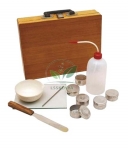
The set includes the cast aluminium pouring cylinder, the calibration container and the tray, as described above. Test sand, a balance and moisture content equipment are separate items, and any further accessories offered are listed on the quotation.
Packing, MOQ and Lead Time
Contractors and colleges can request one set or several for parallel field crews, and each quotation shows the packing, delivery time and price for that number. A core cutter or compactor can be quoted alongside, so field and lab compaction kit comes from one TVET lab equipment supplier.
As a registered exporter with an Importer-Exporter Code, Science Lab Supplies can ship to buyers in Ghana, Ethiopia, Tanzania, Uganda, the UAE and Saudi Arabia. Science Lab Supplies is registered for GST (GSTIN 06ADEPJ0574F2ZU). Enquiries are welcome through the contact page and the enquiry cart, and tender requests through the lab tender page.
Frequently Asked Questions
Which soils is the sand replacement method suited to?
The specification covers compact fine and medium-grained soils in layers not exceeding 50 cm. For gravels and coarse soils, the larger Cone Apparatus in the same range is intended.
Why is there a calibration container?
It is used to find the bulk density of the test sand before fieldwork, so the mass of sand poured into the hole can be converted into the hole's volume.
Who supplies the Sand Replacement Equipment?
Science Lab Supplies supplies it from Ambala, India, quoting colleges, polytechnics, training institutes, contractors and distributors directly.
Should I use sand replacement or a core cutter?
A core cutter suits soft cohesive soils that can be cut cleanly. Sand replacement works where a core cannot be driven or removed intact, such as compacted granular layers.
Related Field Density and Compaction Equipment
Field density is always judged against laboratory compaction, so these Soil Mechanics items complete a compaction-control kit: two other in-place density methods, a compactor for maximum dry density and an oven for moisture contents.
- Core Cutter — density of soft, cohesive soils.
- Cone Apparatus — density of gravels and coarse soils.
- Automatic Mechanical Soil Compactor — laboratory maximum dry density.
- Laboratory Bench Oven — moisture content of excavated soil.
Browse the full Soil Mechanics range or all TVET lab equipment.
Last updated: 25 September 2026