Upright Abacus
Product Code : LSK-ML-10092
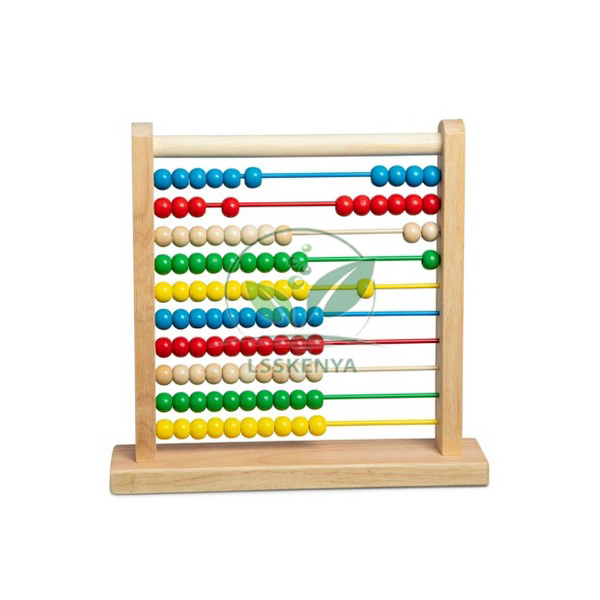
Upright Abacus (SKU LSK-ML-10092) is a standing bead frame: beads slide along a series of wires or rods set in an upright frame, with each rod representing a decimal place. Because the beads face the class, teachers use it to model counting, place value and simple calculation for a group, and pupils then copy the moves. Science Lab Supplies manufactures the abacus in Ambala, India, at Plot 448, HSIIDC Industrial Area, Saha, and supplies schools, contractors and distributors without intermediaries.
Specifications
The upright design stands on a table or teacher's desk with its rods presented vertically in the frame, so everyone can read the bead positions. It is the same calculating principle as a desk abacus, with rods standing for successive decimal places.
| Parameter | Value |
|---|---|
| SKU | LSK-ML-10092 |
| Type | Upright (standing) abacus |
| Working principle | Beads sliding along wires or rods set in a frame |
| Rods | Each represents a decimal place |
| Manufacturer | Science Lab Supplies, Saha, Ambala, Haryana |
| Country of origin | India |
Applications and Experiments for the Upright Abacus
Standing the abacus up turns it into a demonstration tool: the teacher sets a number, the class reads it aloud, and pupils predict what happens when one more bead is added to a full rod. It is a familiar item in maths lab kits for CBSE schools and primary classrooms.
- Whole-class counting and skip counting in the early years.
- NCERT primary place value: showing ones, tens, hundreds and beyond.
- Demonstrating regrouping in addition and subtraction.
- Small-group number games where pupils take turns at the frame.
Standard Scope of Supply
Each Upright Abacus is supplied as a single unit, as described above. Rod and bead numbers and the frame material are not stated in the listing, so the quotation confirms the build you will receive together with any optional accessories you ask to add.
Packing, MOQ and Lead Time
One abacus for a classroom or a batch for every primary section can be quoted. Each quotation shows the packing, delivery time and price for that order size, and Science Lab Supplies, as a science kit manufacturer in India, can add desk abacuses or number boards to it.
Through its Importer-Exporter Code as a registered exporter, Science Lab Supplies can ship to buyers in Sri Lanka, Vietnam, Malaysia, Peru, Egypt and Iraq. The business is registered under Udyam as a manufacturing enterprise (UDYAM-HR-01-0014546) and for GST (GSTIN 06ADEPJ0574F2ZU). Enquiries go through the enquiry cart or contact page, and tender details sit on the lab tender page.
Frequently Asked Questions
When should a school choose the upright model?
Choose it when the abacus will be used to demonstrate to a group, since the beads face the class. For individual work at a pupil's table, the Abacus Desk Table is the matching model.
What does each rod stand for?
Each rod represents one decimal place, so beads on successive rods show ones, tens, hundreds and so on, which is how the frame teaches place value.
Is Science Lab Supplies the manufacturer or a trader?
It is the manufacturer. Science Lab Supplies makes the upright abacus in its own factory at Saha, Ambala, and quotes buyers directly from that factory.
Can it be included in a school tender?
Yes. Send the tender item list and delivery location, and the abacus can be quoted item-wise with the other maths lab equipment required.
Related Counting and Number Aids
Number sense grows from seeing the same idea in several ways. These aids suit a classroom that uses the upright abacus: a desk model and an abacus model for pupils' hands-on work, laminated number lines for sequence, and a number board for spotting patterns.
- Abacus Desk Table — the same bead-frame principle for use at a pupil's desk.
- Abacus Model — movable beads on rods for introductory arithmetic.
- Number Lines — five laminated 5 m lines from ones to hundredths.
- 120 Number Board — basic operations and number pattern activities.
Browse the full Maths Lab range or all school lab equipment.
Last updated: 25 September 2026



.jpg)