
Bend Test Equipment
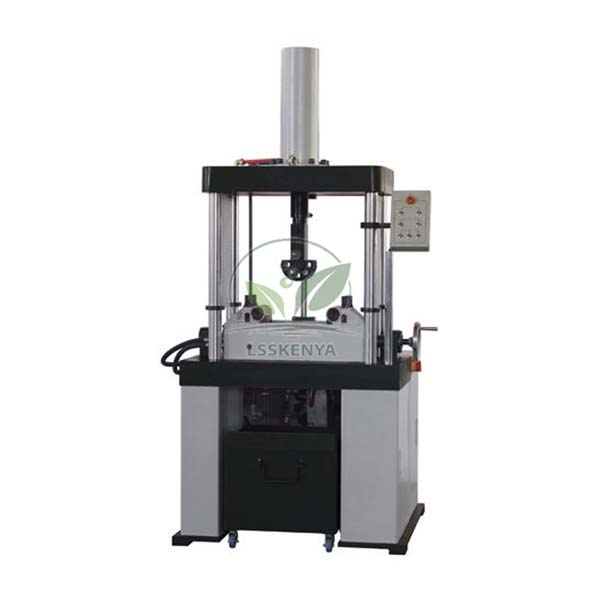
Product Code : LSK-SWES-10699
The Bend Test Equipment bends welded test specimens through 180° in a single step to show whether a weld is sound. A two-way hydraulic cylinder loads, unloads and withdraws quickly, and side loads close the bend to remove leftover deformation. One operator runs a test with push buttons, and the specimen bends into a sealed test table.
Specifications of the Bend Test Equipment
| Specification | Value |
|---|---|
| Bending angle | 180°, formed in one step |
| Drive | Two-way hydraulic cylinder for fast loading, unloading and withdrawing |
| Forming action | Side loads form an interference bend that removes remaining deformation |
| Operation | Push-button control by one operator |
| Ball screw protection | Dust-proof unit keeps oxide scale off the ball screw |
| Specimen handling | Specimen bends into a sealed test table; waste collecting cart |
| Footprint | Small, space-saving |
| Supplied by | Science Lab Supplies, Ambala, India |
Guided Bend Tests on Welded Coupons
Strips are cut across a welded test plate, the weld reinforcement is ground flush and the edges are rounded. Each strip is placed with the weld at the centre of the bend and the surface under test on the outside, then bent to 180° and examined for open defects.
- Stick weld check: bend face and root strips from a butt weld made on the Shielded Metal Arc Welding Machine and record any cracks or pores.
- Specimen preparation: grind the weld cap and root flush with the Angle Grinder, grinding along the length of the strip, not across it.
- Welder progress: test a coupon from each trainee at the start and end of a module and compare the results.
Keep hands out of the test table while the cylinder moves, and wear safety glasses, as a brittle specimen can crack suddenly.
Frequently Asked Questions
How is the bend diameter for a weld test chosen?
Welding codes set the bend diameter as a multiple of specimen thickness, with larger multiples for higher-strength steels. List the plate thicknesses and steel grades the course will test, and check on the technical sheet that the bend diameter of the machine suits those specimens before it is ordered.
How does a plunger-type tester differ from a wrap-around jig?
A plunger jig pushes the specimen down between two supports into a U shape. A wrap-around jig clamps one end and rolls the strip round a fixed mandrel, which suits higher-strength and thinner material. Both aim to stretch the weld surface evenly.
Why choose hydraulic operation over a hand-lever jig?
A hydraulic cylinder gives steady, controlled force at the press of a button, so thick coupons bend at an even rate with one operator and little effort. Lever or screw jigs suit occasional thin coupons but tire trainees and bend at an uneven speed.
What is the difference between a face bend and a root bend?
In a face bend the weld cap side is on the outside of the bend and is stretched, so it tests the top of the weld. In a root bend the root side is stretched, showing lack of penetration or root fusion. Thick plate is often tested with side bends instead.
Why does the test reveal defects that a visual check misses?
Bending stretches the outer surface well past its yield point. Lack of fusion, porosity, slag inclusions and fine cracks open up as visible tears, while sound weld metal and heat-affected zone simply stretch.
Where must the weld sit in the bend?
At the middle of the bend, so that the weld and both heat-affected zones lie inside the bent length. If the weld sits off centre, the plate takes the strain and the test says little about the weld.
Related Weld and Material Testing Equipment
- Bench Top Tensile Testing Machine: pulls metal specimens to failure at loads up to 20 kN.
- Impact Testing Machine: pendulum with an upper starting position for Charpy and a lower one for Izod tests.
- TIG Welding Machine with Thermal Overload Indicator: models from 200 A to 600 A with pulse and water-cooling options.
- Pipe Welding Clamp: aluminium alloy frame with four self-centring clamps and fixed 0, 45 and 90° positions.
- Manual Hand Shear, 12 in Blade: shears round bar up to 13 mm with a hardened high-carbon steel blade.
Weld-quality testing links the Standard Welding Equipment Set with the Material Testing Equipment range.
For weld-testing labs in Saudi Arabia, Oman, the Philippines, Nepal, Bangladesh and Zambia, Science Lab Supplies can arrange export shipment of the bend tester under its Importer-Exporter Code. The enquiry cart and the contact page both take quotation requests for this equipment.
Last updated: 20 November 2026


