DNA Double Helix Model, 22 Segments
Product Code : SCL-PL-12342
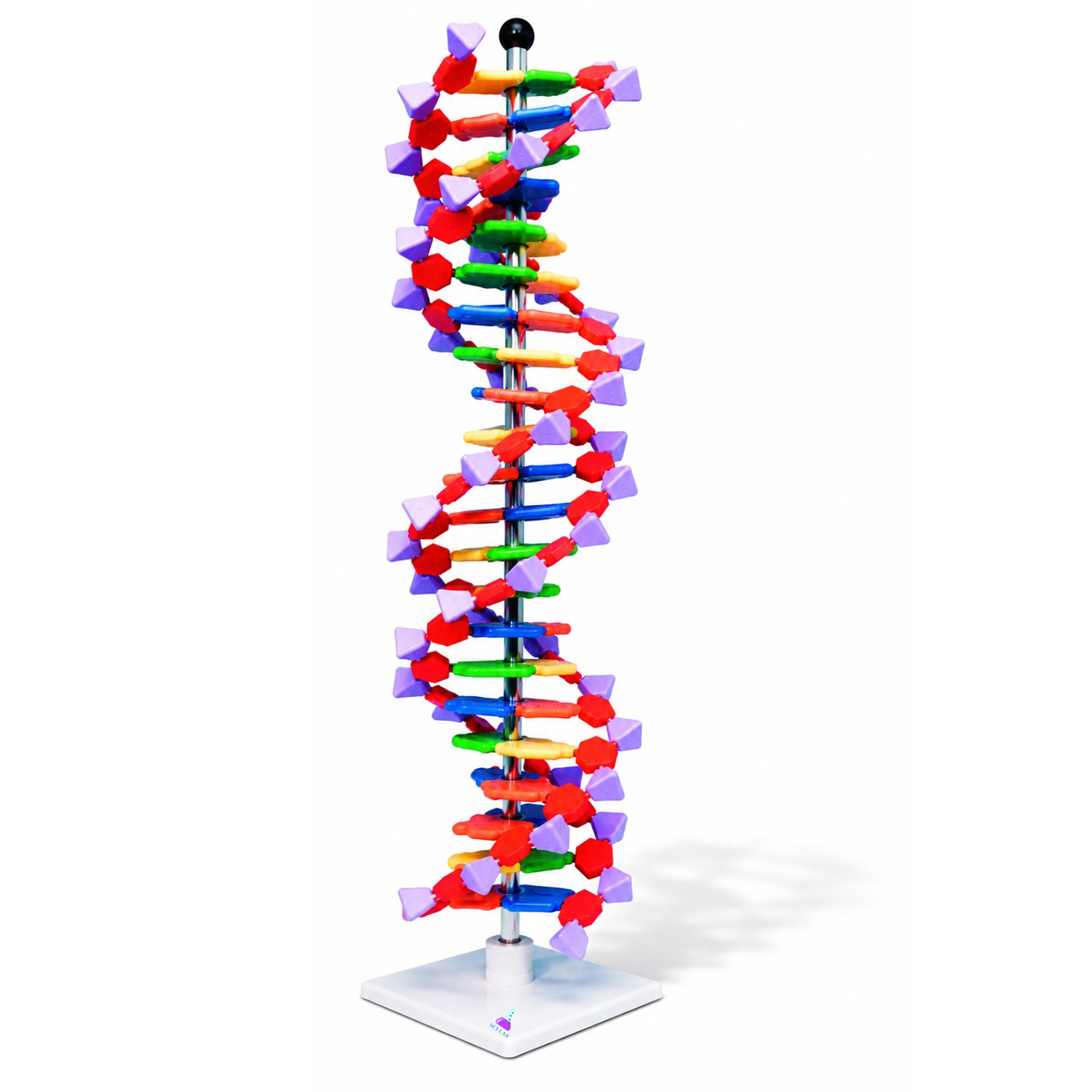
DNA Double Helix Model, 22 Segments (SKU SCL-PL-12342) is a build-it-yourself molecular kit from which students assemble a right-handed DNA double helix out of colour-coded bases, sugars and phosphate groups. It supports genetics and molecular biology lessons from Class 10 to Class 12 and in B.Sc. and nursing courses. Science Lab Supplies produces the kit at its manufacturing unit in the HSIIDC Industrial Area, Saha, Ambala, India, and sells it straight to schools, colleges, tender contractors and distributors.
Specifications
The kit has 44 base pieces, 44 deoxyribose sugars and 44 phosphate groups, each type in its own colour so the chemical make-up of DNA is visible at a glance. Once built on its stand, the helix measures 44 x 11 x 11 cm and the kit weighs 0.5 kg.
| Parameter | Value |
|---|---|
| SKU | SCL-PL-12342 |
| Helix | Right-handed double helix, 22 segments |
| Bases | 11 thymine (orange), 11 adenine (blue), 11 guanine (green), 11 cytosine (yellow) |
| Backbone parts | 44 deoxyribose (red); 44 phosphate groups (violet) |
| Accessories | Stand; assembly instructions |
| Weight | 0.5 kg |
| Dimensions | 44 x 11 x 11 cm |
| Manufacturer | Science Lab Supplies, Saha, Ambala, Haryana |
| Country of origin | India |
Applications and Experiments for the DNA Double Helix Model
Building the helix piece by piece makes the structure of DNA concrete: students join sugars and phosphates into two backbones, pair adenine with thymine and guanine with cytosine, and then separate the strands to act out replication. These biology models for schools make an abstract topic hands-on.
- Class 10 science: heredity and the idea of DNA as genetic material.
- Class 12 biology: molecular basis of inheritance, the double helix and complementary base pairing.
- Semi-conservative DNA replication, modelled by unzipping and rebuilding strands.
- B.Sc. botany, zoology and biotechnology, and nursing genetics: nucleotide structure revision.
Standard Scope of Supply
Each kit contains 11 each of thymine, adenine, guanine and cytosine, 44 deoxyribose pieces and 44 phosphate groups, together with a stand to display the finished helix and assembly instructions for building it. Optional extras, if any, are shown separately on the quotation.
Packing, MOQ and Lead Time
Order a single kit for demonstration or one per student group for a practical session; either way, the quotation lists packing, delivery time and price for that quantity. Molecular model kits for chemistry can be added to the same quotation.
Science Lab Supplies is a registered exporter under an Importer-Exporter Code and can ship to buyers in Nigeria, Kenya, Ghana, Ethiopia, Tanzania and Uganda. Reach us on the contact page, collect products in the enquiry cart, or see how tender orders work on the lab tender page.
Frequently Asked Questions
What colours represent each part of the DNA model?
Thymine is orange, adenine blue, guanine green and cytosine yellow; the deoxyribose sugars are red and the phosphate groups violet.
Can the model show DNA replication?
Yes. The two strands can be pulled apart to show how each acts as a template for a new partner strand, so students can model replication and complementary base pairing.
Is Science Lab Supplies the manufacturer or a trader?
Science Lab Supplies manufactures the kit in Saha, Ambala, India. Buying from it means dealing with the factory itself, which also prepares your quotation.
Does the kit come with instructions and a stand?
Yes. Assembly instructions and a stand are included, so the completed 44 cm helix can be displayed after the lesson.
Related Molecular and Microscopy Items
The four items below from the same range extend the DNA lesson: molecular model kits for chemistry bonding in teacher and student versions, and microscopy sets for looking at cells, where DNA is found. Any combination can be quoted with the helix model.
- Molecular Model Kits for Teachers — teacher's version with about 108 atoms in the inorganic/organic set.
- Molecular Model Kits for Students — student version with about 52 atoms in the inorganic/organic set.
- Teaching Microscope and Prepared Slides — trinocular microscope for cell studies.
- Biology Set BM1 – Microscopy — 8 introductory microscopy experiments.
Browse the full Physics Lab range or all physics lab equipment.
Last updated: 25 September 2026
.jpg)