Hydrology And Rainfall Apparatus
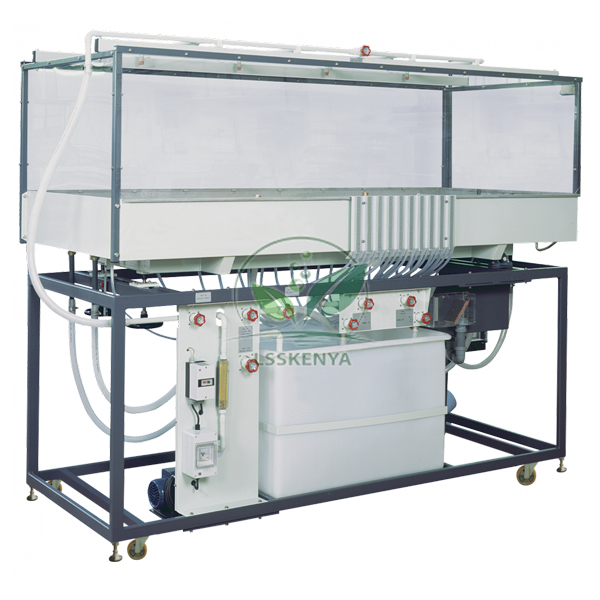
Product Code : LSK-FM-10469
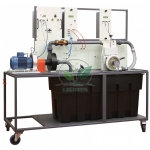
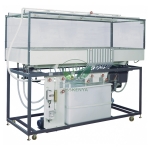
Hydrology And Rainfall Apparatus (SKU LSK-FM-10469) is a tilting catchment tank with overhead spray nozzles that simulate rainfall, so students can study runoff, hydrographs, groundwater levels and flow to wells. It is aimed at hydrology and water-resources practicals in civil and agricultural engineering. From its manufacturing unit at Plot 448, HSIIDC Industrial Area, Saha, Ambala, India, Science Lab Supplies supplies the apparatus to universities, tender contractors and distributors.
Specifications
The rainfall catchment rig is broken down into single facts in the table below. In short, a sturdy metal frame carries a large stainless-steel catchment tank above a reservoir; a pump feeds the overhead nozzles and the tank ends, a jacking mechanism sets the slope, and twenty slotted tappings report the water table to a piezometer bank.
| Specification | Value |
|---|---|
| SKU | LSK-FM-10469 |
| Frame | Sturdy metal frame |
| Catchment area | Large rectangular stainless-steel tank |
| Reservoir | Reservoir tank held in the same frame |
| Catchment slope | Adjustable by jacking mechanism |
| Catchment medium | Granular medium, available separately |
| Rainfall | Spray nozzles on a frame above the catchment |
| Nozzle selection | Valve selects all or half of the nozzles |
| Pump | Draws from the reservoir and feeds the nozzles and the ends of the catchment |
| Flow adjustment | Variable flow to the nozzles and to the tank |
| Overall flow measurement | Flow meter |
| Water-table tappings | 20, along the centre line, with slotted ends that keep the medium out |
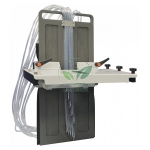
| Piezometers | Bank of piezometer tubes at the front of the catchment |
| Wells | Two, in the middle of the catchment |
| End compartments | Separated from the catchment by weir plates with porous port holes |
| Outflow measurement | Calibrated rectangular weir under the catchment, for flow from the wells or the tank |
| Manufacturer | Science Lab Supplies, Saha, Ambala, Haryana |
| Country of origin | India |
Applications and Experiments for the Hydrology and Rainfall Apparatus
Students apply controlled rainfall to a sloping granular catchment and measure the outflow over time to build hydrographs, then use the tappings and wells to study groundwater. These experiments suit B.Tech/B.E. civil engineering hydrology and water-resources labs and agricultural engineering courses.
- Rainfall–runoff hydrographs for different intensities and catchment slopes, with readings timed on School Digital Stopwatches that record lap and split times.
- Changing hydrograph lag time, or simulating a moving storm, by switching half the nozzles.
- Water-table profiles and drawdown around one or two pumping wells.
- Recharge and drainage of the catchment through the porous end compartments, with the granular medium described against a Grain Size Chart.
Standard Scope of Supply
The apparatus comes as the frame with catchment and reservoir tanks, pump, spray-nozzle frame with selector valve, flow meter, jacking mechanism, 20 tappings with piezometer bank, two wells, porous-port end compartments and the calibrated rectangular weir. The granular medium that fills the catchment is available separately.
Packing, MOQ and Lead Time
You may request a price for one apparatus or for a full water-resources laboratory; the reply states the packing, delivery time and price for exactly what you list. The granular medium and related engineering lab equipment in India can be included in the same quotation.
Science Lab Supplies has an Importer-Exporter Code and is able to ship to buyers in Peru, Egypt, Iraq, Nigeria, Kenya and Ghana. Name the catchment rig and the medium you want in a message on the contact page or in the enquiry cart; university and government tenders are handled through the lab tender page.
Frequently Asked Questions
Is the sand or gravel for the catchment included?
No. The granular medium that forms the permeable catchment is available separately, so the sand or gravel grade you want can be added to the same quotation as the apparatus.
How is outflow from the catchment measured?
A calibrated rectangular weir under the catchment measures flow from the wells or the tank, while a flow meter records the overall flow delivered by the pump.
Can the rainfall pattern be changed?
Yes. Students vary the flow to the nozzles, and a valve selects all or half of the nozzles to alter the hydrograph lag time or simulate a storm moving across the catchment.
Is Science Lab Supplies the manufacturer or a trader?
The stainless-steel catchment, frame and nozzle system come from the Science Lab Supplies factory in Saha, Ambala, India, which also prepares the price, so there is no trading intermediary between you and the maker.
Related Hydrology, Weir and Soil Equipment
These items extend the catchment studies to seepage, weir flow measurement, spillways, sediment movement and soil permeability, topics that fit the same civil engineering hydrology syllabus as rainfall–runoff work. Any of them can be priced together with the rainfall apparatus.
- Permeability, Flow Nets And Darcy's Law — filtered rear tappings read the head distribution along a sand-filled tank.
- Discharge Over a Notch — weirs fit sealed grooves in a channel; an adjustable depth gauge reads the water surface.
- Notched Weirs — holder with rectangular, V and Cipoletti (trapezoidal) notches.
- Liquid Sedimentation Apparatus — five settling columns with a stopwatch and specific gravity bottle.
- Spillway — for observing and calculating flow and energy dissipation over spillways.
- Sediment Loop — catches washed-out sediment in a vessel ready to be re-circulated.
- Soil Permeability Apparatus — mould with porous stones, drainage cap and three glass stand pipes.
Browse the full Fluid Mechanics range, the Soil Mechanics range or all engineering laboratory equipment.
Last updated: 22 October 2026