Electrolysis Kit
Product Code : LSK-CL-10248
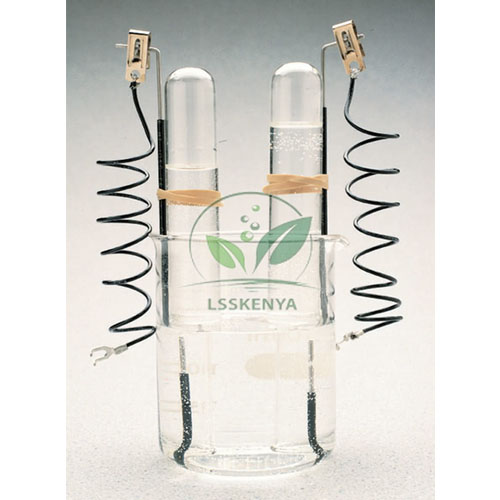
Electrolysis Kit (SKU LSK-CL-10248) is a simple set of electrodes, leads and seals for splitting water into hydrogen and oxygen using ordinary test tubes and a beaker. It lets students confirm the constitution of water with their own hands rather than watching a glass voltameter from a distance, which makes it a good fit for group work in secondary science. Science Lab Supplies supplies the kit from Ambala, India to schools, colleges, training institutes, tender contractors and distributors.
Specifications
The kit centres on two stainless steel electrodes that are heavily insulated, connected by two leads fitted with extra-large clips for a secure grip on a power source. Two rubber gaskets seal the filled test tubes while they are inverted and placed into the beaker, so no air enters before the gases are collected.
| Parameter | Value |
|---|---|
| SKU | LSK-CL-10248 |
| Electrodes | 2, stainless steel, heavily insulated |
| Connection leads | 2, with extra-large clips |
| Seals | 2 rubber gaskets for inverting filled test tubes |
| Glassware | Not included |
| Supplied by | Science Lab Supplies, Ambala, India |
Applications and Experiments for the Electrolysis Kit
The kit is used to decompose water by electrolysis and collect the two gases in separate test tubes. Students compare the volumes, then test each gas: hydrogen gives a squeaky pop with a burning splint and oxygen relights a glowing one, confirming what water is made of.
- Class 10 science (NCERT): electrolysis of water as a decomposition reaction.
- Class 8–9 science: evidence that water is a compound of hydrogen and oxygen.
- Class 12 chemistry: introductory electrolysis before quantitative voltameter work.
Hydrogen is flammable, so test only the small volumes collected and keep flames away from the power source. Any acid or salt added to the water should be handled with eye protection and teacher supervision.
Standard Scope of Supply
Each kit contains two insulated stainless steel electrodes, two connection leads with extra-large clips and two rubber gaskets. Glassware is not included, so the test tubes and beaker come from your lab or can be added to the order; the kit contents do not list a power source.
Packing, MOQ and Lead Time
Because the kit suits group work, schools often ask for one per bench. Science Lab Supplies will quote a single kit or a class quantity, stating packing, delivery time and price, and can add beakers, test tubes and a power supply from its school chemistry lab equipment in India.
As a registered exporter with an Importer-Exporter Code, Science Lab Supplies can ship to buyers in Malaysia, Peru, Egypt, Iraq, Nigeria and Kenya. Science Lab Supplies is registered for GST (GSTIN 06ADEPJ0574F2ZU). Enquiries are welcome through the contact page and the enquiry cart, and tender details are on the lab tender page.
Frequently Asked Questions
Is glassware included in the Electrolysis Kit?
No. The kit supplies the electrodes, leads and gaskets only. You need two test tubes and a beaker, which can be taken from the lab or added to the quotation.
What are the rubber gaskets for?
They seal the filled test tubes while they are turned upside down and lowered into the beaker, so the tubes stay full of water until the gases displace it.
Who supplies the Electrolysis Kit?
Science Lab Supplies, a laboratory equipment supplier in India based in Ambala, supplies this kit along with voltameters, electrodes and power supplies for school electrochemistry.
How does this kit differ from a Hoffman voltameter?
This kit uses ordinary test tubes and stainless steel electrodes for simple group work. A Hoffman voltameter is a graduated glass apparatus used for measured gas volumes.
Related Electrolysis Equipment
To run the kit a lab needs glassware and a power source, and many schools also keep a graduated voltameter for quantitative work. These four items from the range complete an electrolysis practical.
- Electrolysis Kit — another electrolysis kit in the range.
- Hoffman Voltameter With Electrodes — graduated apparatus for measured volumes.
- Beakers — the vessel the inverted test tubes stand in.
- Universal Power Supply or Power Driver — a power source for the leads.
Browse the full Chemistry Lab range or all school lab equipment.
Last updated: 25 September 2026


250ml.jpg)