Salt Bridge
Product Code : LSK-CL-10267
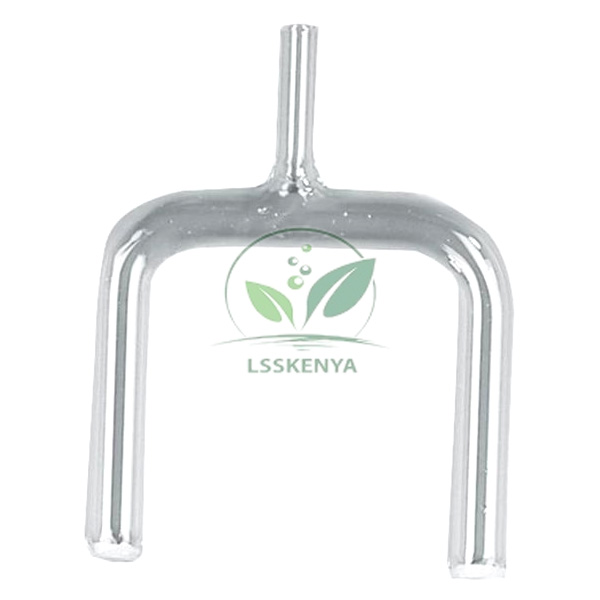
Salt Bridge (SKU LSK-CL-10267) is an inverted U-tube whose two ends are closed by sintered discs, used to link two half-cells so ions can move between them while the solutions stay separate. Chemistry departments use it to build galvanic cells from two beakers in Class 12 and undergraduate electrochemistry. Science Lab Supplies, a laboratory equipment supplier in India, sends it from Ambala to schools, colleges, training institutes, tender contractors and distributors.
Specifications
The bridge is a single inverted U-tube with arms 13 mm in diameter, an overall width of 80 mm and a height of 100 mm. Sintered discs seal both ends, so the tube can be filled with an electrolyte and stood in two beakers without the filling running out.
| Parameter | Value |
|---|---|
| SKU | LSK-CL-10267 |
| Form | Inverted U-tube |
| Ends | Closed by sintered discs |
| Dimensions (dia. x W x H) | Arms 13 mm x 80 mm x 100 mm |
| Supplied by | Science Lab Supplies, Ambala, India |
Applications and Experiments for the Salt Bridge
A salt bridge completes the internal circuit of a two-beaker cell. Filled with an inert electrolyte such as potassium chloride or potassium nitrate solution, it lets ions flow to balance charge while keeping the two electrode solutions from mixing, so the cell keeps producing a steady voltage.
- NCERT Class 12 chemistry: setting up a zinc–copper galvanic cell and explaining the role of the salt bridge.
- Class 12 practical: measuring cell EMF and showing that the reading drops to zero when the bridge is removed.
- B.Sc. physical chemistry: building concentration cells and comparing electrode potentials.
After use, rinse the tube and soak the sintered ends in distilled water so salt does not crystallise in the pores.
Standard Scope of Supply
The Salt Bridge is supplied as a single unit as described above: one inverted U-tube with sintered discs at both ends. The electrolyte for filling it, the beakers and the electrodes of the half-cells are not part of this item and can be quoted separately.
Packing, MOQ and Lead Time
You may request a price for one salt bridge or for enough to equip every student bench. The quotation we send sets out packing, delivery time and price for that quantity, and half-cell electrodes or beakers from our chemistry lab equipment range can be combined on it.
Registered as an exporter with an Importer-Exporter Code, Science Lab Supplies can ship to buyers in Qatar, Sri Lanka, Vietnam, Malaysia, Peru and Egypt. The quickest routes for an enquiry are the contact page and the enquiry cart, while tender buyers can use the lab tender page.
Frequently Asked Questions
What does a salt bridge do in a galvanic cell?
It connects the two half-cells so ions can migrate and keep each solution electrically neutral. Without it, charge builds up and the current stops almost at once.
Why does this bridge have sintered ends?
The sintered discs let ions pass but slow the flow of liquid, so the bridge stays filled and the two electrode solutions do not mix, unlike an open tube or a paper strip.
Who supplies the Salt Bridge?
It is supplied by Science Lab Supplies from Ambala, India, and can be quoted for schools, colleges, contractors and distributors along with other electrochemistry items.
Is the filling solution included?
No. The laboratory fills the tube with its chosen electrolyte, commonly potassium chloride or potassium nitrate solution, before each experiment.
Related Galvanic Cell Apparatus
A salt bridge is only one part of a working cell. These items supply the rest of a galvanic cell practical, from a ready-made porous-pot cell to a demonstration set with its own galvanometer, and can go on the same quotation as the bridge.
- Daniel Cell — porous-pot cell giving about 1.1 V.
- Apparatus for Demonstrating the Galvanic Element (With Galvanometer) — demonstration cell with a meter.
- Volta Battery (Glass Type) — cells connected in series.
- Salt Bridge — another salt bridge listing in the same range.
Browse the full Chemistry Lab range or all school lab equipment.
Last updated: 25 September 2026