Sodium Chloride Crystal Model
Product Code : LSK-CL-10076
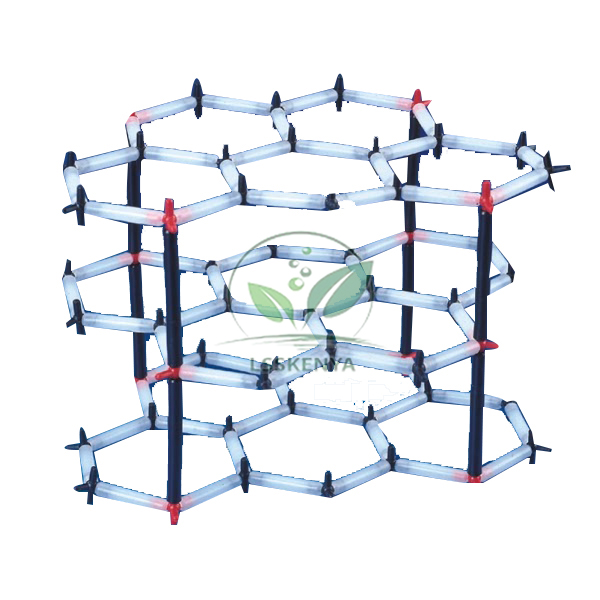
Sodium Chloride Crystal Model (SKU LSK-CL-10076), also called a NaCl lattice model or rock-salt structure model, is a kit for building the ionic crystal of common salt, where sodium and chloride ions alternate in a cubic arrangement. It is used to teach ionic bonding and crystal lattices in school and first-year college chemistry. Science Lab Supplies sends it from Ambala, India, to schools, colleges, tender contractors and distributors.
Specifications
This model of the compound uses two colours of jacks, 13 black and 14 red, so the two kinds of ion can be told apart at a glance, joined by 54 connectors. It arrives with an instruction manual, is assembled by the class and can be dismantled again for storage.
| Parameter | Value |
|---|---|
| SKU | LSK-CL-10076 |
| Also known as | NaCl lattice model, rock-salt structure model |
| Black jacks | 13 |
| Red jacks | 14 |
| Connectors | 54 |
| Documentation | Instruction manual included |
| Supplied by | Science Lab Supplies, Ambala, India |
Applications and Experiments for the Sodium Chloride Crystal Model
The assembled lattice shows that each sodium ion is surrounded by six chloride ions and each chloride by six sodium ions, with no separate molecules. It supports ionic bonding in NCERT Class 10, the solid state and crystal lattice topics of Class 11–12, and inorganic chemistry practicals in B.Sc. courses.
- Class 10 metals and non-metals: how sodium and chlorine form an ionic compound.
- Class 12 solid state: face-centred cubic packing and a coordination number of six.
- B.Sc. inorganic chemistry: comparing ionic lattices with covalent network solids.
- Explaining high melting point, brittleness and conduction when molten or dissolved.
Standard Scope of Supply
The kit is supplied with 13 black jacks, 14 red jacks and 54 connectors, plus the instruction manual for assembling the sodium chloride lattice. All parts come loose for building in class, so the same kit can be used again by later groups.
Packing, MOQ and Lead Time
Whether you need one kit for the teacher or a set for each bench, send the number and Science Lab Supplies will quote the packing, delivery time and price for it. The diamond and graphite lattice kits, or other chemistry lab equipment in India from this range, can share the quotation.
With an Importer-Exporter Code as a registered exporter, Science Lab Supplies can ship to buyers in Nigeria, Kenya, Ghana, Ethiopia, Tanzania and Uganda. Science Lab Supplies is registered for GST (GSTIN 06ADEPJ0574F2ZU). Enquiries go through the contact page or the enquiry cart, and the lab tender page explains tender supply.
Frequently Asked Questions
Why are there two colours of jacks?
The 13 black and 14 red jacks stand for the two kinds of ion, sodium and chloride, so students can see how they alternate through the lattice. The instruction manual shows the arrangement.
What is included in the Sodium Chloride Crystal Model?
Each kit contains 27 jacks in two colours, 54 connectors and an instruction manual. It is supplied unassembled and is built during the lesson.
Who supplies this sodium chloride model?
Science Lab Supplies supplies it from Ambala, India, to schools, colleges, tender contractors and distributors, and quotes for single kits or larger class quantities.
Which topics does the model support?
Ionic bonding, crystal lattices, coordination number and the physical properties of ionic solids, from Class 10 science to first-year B.Sc. chemistry.
Related Structure Models
An ionic lattice is easiest to understand when set against covalent ones, so the diamond and graphite kits make natural partners. A demonstration kit and a general molecular model set cover the molecules that sit between them, giving a complete bench of structure models for bonding lessons.
- Diamond Crystal Model — a covalent network solid for contrast.
- Graphite Crystal Model — a layered covalent structure.
- Molecular Models Demonstration Kit — discrete molecules for front-bench teaching.
- Atomic In/Organic Junior Model — ball models of inorganic and organic compounds.
Browse the full Chemistry Lab range or all school lab equipment.
Last updated: 25 September 2026