Core Cutter
Product Code : LSK-SM-10659
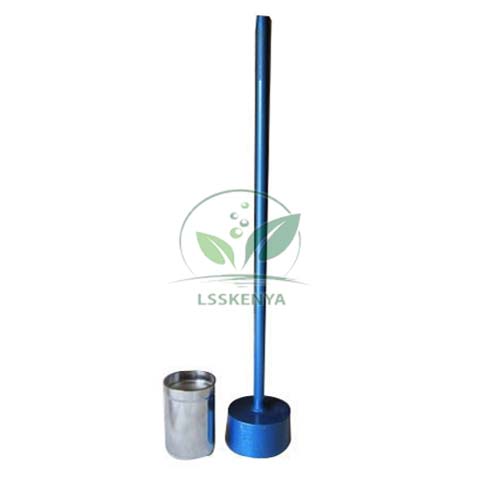
Core Cutter (SKU LSK-SM-10659) is a steel cylinder that is driven into the ground to take a soil core of known volume, from which the field density and moisture content of the soil are calculated. It suits soft, fine-grained soils free of stones. Civil engineering colleges, polytechnics and TVET road construction courses use it in field density practicals. The set is available from Science Lab Supplies, Ambala, India, for direct purchase by institutes and colleges or through tender contractors and distributors.
Specifications
The cutter is made of steel protected against corrosion and is offered in two sizes: 100 mm diameter x 130 mm high, or 150 mm diameter x 180 mm high. A driving dolly sits on top of the cutter, and the driving rammer forces both into the soil to the required depth.
| Parameter | Value |
|---|---|
| SKU | LSK-SM-10659 |
| Material | Steel, protected against corrosion |
| Sizes available | 100 mm dia x 130 mm high; 150 mm dia x 180 mm high |
| Set contents | Core cutter, driving dolly, driving rammer |
| Test | Field density and moisture content of soil |
| Supplied by | Science Lab Supplies, Ambala, India |
Applications and Experiments for the Core Cutter
The core cutter method gives the in-place dry density of compacted or natural soil: the filled cutter is dug out, trimmed flush, weighed, and a sample dried for moisture content. Students then compare field dry density with laboratory compaction results in degree, diploma and TVET soil mechanics practicals.
- B.E./B.Tech civil engineering: field density by the core cutter method.
- Diploma civil engineering: checking compaction of embankments and earthworks.
- TVET road construction modules: site quality control of subgrade layers.
Keep hands clear of the dolly while driving with the rammer, and wear gloves and safety footwear during field work.
Standard Scope of Supply
Each set includes the core cutter, a driving dolly and a driving rammer. State whether you need the 100 x 130 mm or the 150 x 180 mm version, or both, when asking for a quotation. The balance, spade and moisture tins used in the test are separate items.
Packing, MOQ and Lead Time
Quotations are available for one set or for enough sets for every student group, and each shows packing, delivery time and price for the quantity. Both cutter sizes, and an oven for moisture content, can be listed together on one quotation.
With an Importer-Exporter Code, Science Lab Supplies is a registered exporter that can ship to buyers in Bangladesh, Zambia, Rwanda, South Africa, Qatar and Sri Lanka. Write to the team via the contact page, add the set to the enquiry cart, or view the lab tender page for institutional tenders.
Frequently Asked Questions
What sizes of Core Cutter are available?
Two: 100 mm diameter x 130 mm high, and 150 mm diameter x 180 mm high. Both are steel, protected against corrosion, and come with a driving dolly and rammer.
How is the field density worked out?
The known cutter volume and the mass of the trimmed soil core give the bulk density; drying a sample for moisture content then gives the dry density.
Which soils suit the core cutter method?
Soft, fine-grained soils without stones. For gravels and coarse soils, a sand cone or sand replacement method is normally used instead.
Who supplies the Core Cutter?
Science Lab Supplies, a TVET lab equipment supplier in Ambala, India, supplies it and can quote both sizes together with other vocational training equipment for soil labs.
Related Soil Density and Compaction Equipment
Field density results mean most when set against other density methods and laboratory compaction. These four items from the Soil Mechanics range cover coarse soils, moisture content and compaction, and can be ordered on the same quotation as the core cutter.
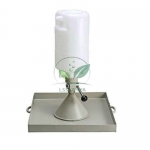
- Sand Replacement Equipment — field density where a cutter cannot be driven.
- Cone Apparatus — density of gravels and coarse soils.
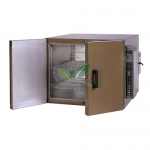
- Laboratory Bench Oven — moisture content of the core.
- Automatic Mechanical Soil Compactor — laboratory compaction for comparison.
Browse the full Soil Mechanics range or all TVET lab equipment.
Last updated: 25 September 2026