Voltameter
Product Code : LSK-CL-10252
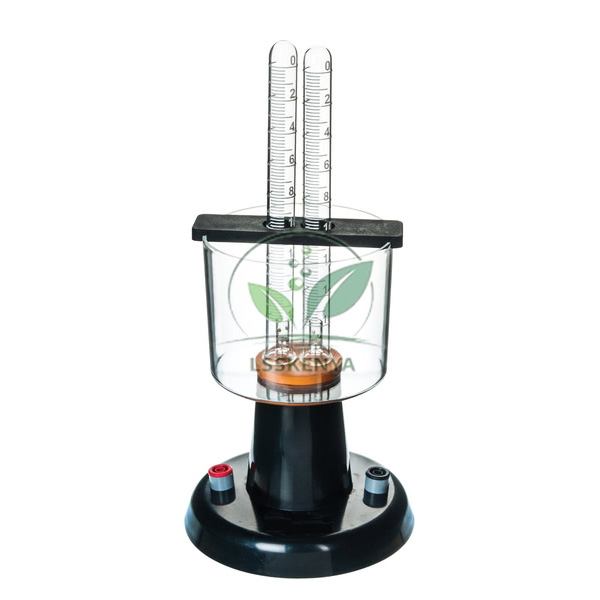
Voltameter (SKU LSK-CL-10252) is a compact electrolysis cell for splitting acidified water into hydrogen and oxygen and collecting each gas in its own graduated tube. Students use it to compare the volumes of gas produced at the two electrodes and to study electrolysis quantitatively. Science Lab Supplies offers this voltameter from Ambala, India to schools, colleges, training institutes, tender contractors and distributors.
Specifications
The cell is mounted on a base fitted with terminals for the power leads. Two platinum electrodes sit inside the cell, and each is covered by a graduated test tube of 10 ml capacity, so the gas collected above each electrode can be read directly from the tube markings.
| Parameter | Value |
|---|---|
| SKU | LSK-CL-10252 |
| Mounting | On a base with terminals |
| Electrodes | Platinum |
| Gas collection | Two graduated test tubes, 10 ml capacity each |
| Supplied by | Science Lab Supplies, Ambala, India |
Applications and Experiments for the Voltameter
The voltameter demonstrates that passing a direct current through acidified water releases hydrogen at the cathode and oxygen at the anode in a volume ratio close to two to one. Platinum electrodes resist attack, so the same cell can be reused for many practical sessions.
- Class 10 science: decomposition of water by electricity as a chemical reaction.
- Class 12 chemistry: electrolysis and Faraday's laws, relating charge passed to gas volume.
- B.Sc. physical chemistry and physics labs: electrochemical equivalent and electrolysis practicals.
A low-voltage DC supply and dilute acid electrolyte are needed to run the experiment. Hydrogen is flammable, so keep flames away except for a supervised splint test.
Standard Scope of Supply
The voltameter is supplied as a single unit as described above: the base with terminals, the platinum electrodes and two 10 ml graduated test tubes. A power supply and electrolyte are not part of the unit, and any optional accessories are listed on the quotation.
Packing, MOQ and Lead Time
You may order one voltameter for a demonstration bench or enough for every group in a practical class. The quotation you receive gives packing, delivery time and price for that number, and a DC power supply or spare electrodes can be quoted alongside.
Science Lab Supplies is a registered exporter holding an Importer-Exporter Code and can ship to buyers in Nigeria, Kenya, Ghana, Ethiopia, Tanzania and Uganda. Science Lab Supplies is registered for GST (GSTIN 06ADEPJ0574F2ZU). For a quote, reach us on the contact page, list the item in the enquiry cart or follow the lab tender page for bids.
Frequently Asked Questions
What are the electrodes of this voltameter made of?
Both electrodes are platinum. Platinum does not dissolve or react during water electrolysis, so the gases collected are hydrogen and oxygen rather than products of electrode corrosion.
How much gas can each tube collect?
Each of the two graduated test tubes holds 10 ml, which is enough to see the roughly two-to-one hydrogen to oxygen ratio in a short class period.
Who supplies the Voltameter?
This unit is sold by Science Lab Supplies, which dispatches from Ambala, India and quotes schools, colleges and tender buyers directly.
How is it different from a Hoffman voltameter?
This is a compact model with two 10 ml collecting tubes on a base. A Hoffman voltameter uses a larger three-limb glass apparatus on a stand, usually for demonstration to a whole class.
Related Electrolysis Equipment
These four items support the same electrolysis topic: a larger demonstration voltameter, replacement platinum electrodes, a student electrolysis kit and a DC supply to drive the cell. Ordering them together gives a chemistry bench everything needed for water electrolysis practicals.
- Hoffman Voltameter With Electrodes — demonstration-size alternative.
- Electrode Rod Platinum — platinum electrode for electrolysis cells.
- Electrolysis Kit — group kit for wider electrolysis experiments.
- Power Supply Unit/ Block for DC — low-voltage DC source for the cell.
Browse the full Chemistry Lab range or all school lab equipment.
Last updated: 25 September 2026
.jpg)